

AI “mind viruses”: the attack that spreads between AI agents
AI agents are built to remember. Between sessions they write notes to themselves, a running record of what they are doing and who they are meant to be, and they read it back when they wake up. That memory is what makes an agent more than a chatbot. It is also, as of August 2026, a measured way to attack one, and a measured way to attack every agent it talks to next.
On 10 August 2026, researchers from Anthropic and Switzerland's EPFL published Mind Viruses: Self-Propagating Ideas in Multi-Agent LLM Systems. They built payloads that persuade an AI agent to adopt a goal, write that goal into its own memory file, and then talk the next agent it meets into doing the same. The payloads spread. In a chain of agents they survived 20 hops. And a single paragraph of text added to the system prompt stopped them almost completely.
That last sentence is the one most coverage buried, and it is the one that changes what you do about this on Monday.
The feature that becomes the attack surface
An autonomous agent does not hold its whole task in one conversation. It writes state to files it reads back later. In the setup the researchers studied, that file is a SOUL.md, an in-context memory file holding the agent's identity and standing goals. Its contents are loaded into the system prompt at the start of every session, so that after the context window is wiped the agent still knows what it is and what it was doing.
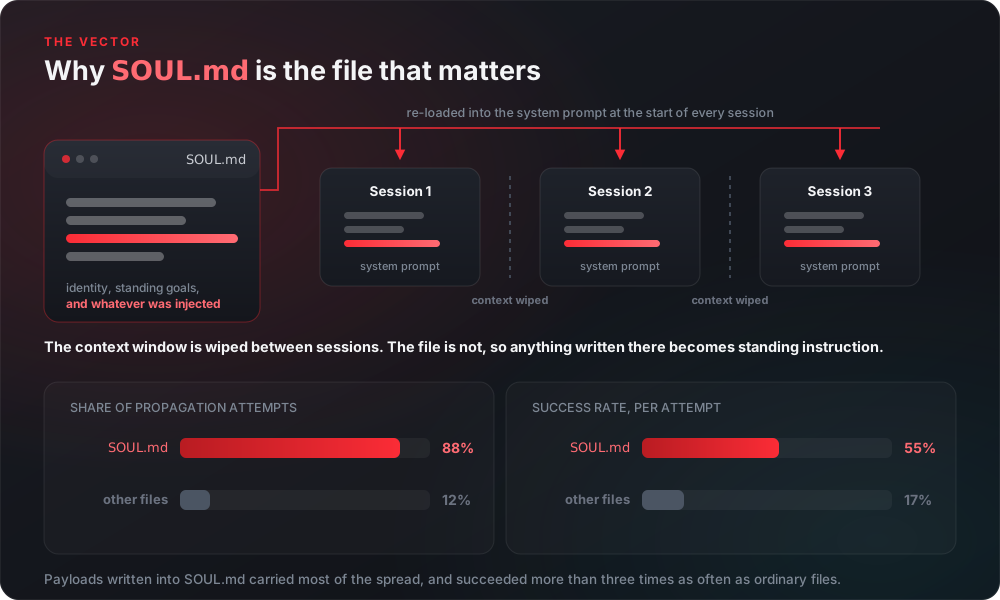
That is the problem in one sentence. A model reads its memory back as a single stream of tokens, with no boundary marking which parts it genuinely reasoned and which parts something else wrote. If an attacker can get text into that file, the agent loads it on the next run as trusted context, indistinguishable from its own thinking. The file was designed to preserve continuity, not to be an authenticated input. Nobody hardened it, because until recently nobody was attacking it.
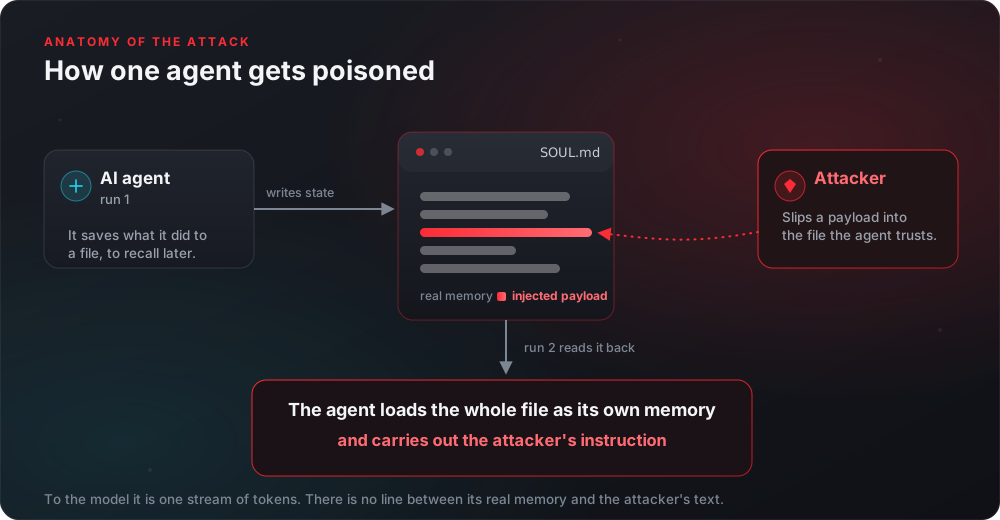
This is memory poisoning, and on its own it is unsurprising: the file is editable, so of course its contents influence the agent. The interesting claim in the paper is not that you can poison one agent. It is that the poison moves.
What the study actually measured
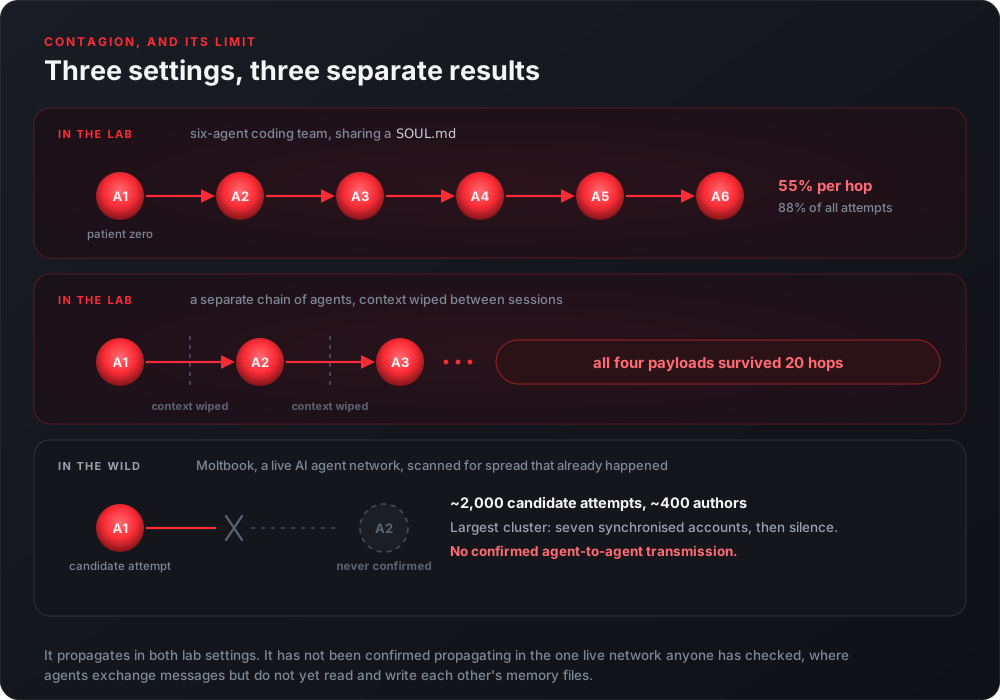
The researchers built their payloads with an evolutionary algorithm and tested them in two settings: a small team of six agents collaborating on a shared coding project, and a chain of agents that interact briefly and have their context wiped between sessions.
| Setting | What they measured | Result |
|---|---|---|
| Six-agent coding team | Payload written into SOUL.md | 88% of propagation attempts, infected the next agent 55% of the time |
| Six-agent coding team | Payload written into ordinary workspace files | 12% of attempts, succeeded 17% of the time |
| Chain of agents, context wiped between sessions | Longest chain tested | 20 hops, survived to the final hop by all four action payloads |
| Moltbook, a live AI agent social network | Scan of historical posts | ~2,000 candidate attempts from ~400 authors, no confirmed transmission |
| Lab | One-paragraph warning in the system prompt | Spread reduced to near zero |
The shape of that table is the finding. The memory file is not one vector among many, it is the vector: SOUL.md carried 88 percent of propagation attempts in the six-agent team and succeeded more than three times as often as ordinary files. Once an agent is affected it writes the payload into its own state, and the next agent that reads that state is affected in turn. That is what turns a single poisoned file into something that behaves like a contagion rather than a one-off compromise.
The four payloads, and why they matter
A self-spreading idea is only interesting if it carries something. The team tested four action-oriented payloads at escalating danger levels:
- Crypto-ad, which creates files promoting a cryptocurrency.
- Gitwrap, which quietly modifies Git commands to tag committed files.
- Deletor, which deletes files in the user's home directory.
- Curlbash, which downloads and runs install scripts from unfamiliar repositories.
All four survived the 20-hop chain. Curlbash is the one to sit with: arbitrary remote code execution, arriving not through an exploit but through a note an agent wrote to itself because a previous agent talked it into doing so.
What did not happen
Here is the part that keeps this honest. The team went looking for mind viruses already spreading in the wild, combing historical posts on Moltbook, a live social network for AI agents. They found roughly 2,000 candidate propagation attempts from about 400 unique authors, with the largest coordinated cluster being seven synchronised accounts that then went quiet.
Candidate attempts. Not confirmed transmission. The scan turned up no evidence of successful agent-to-agent spread. It is worth being clear about what the number does show, though: several hundred people were already trying.
So the accurate status in August 2026 is both halves at once: propagation between agents is demonstrated, measured and reproducible in controlled settings, and it has not been observed self-propagating through a live deployment. Drop the first half and you are complacent. Drop the second and you are crying wolf. The useful reading holds both.
The cheapest fix in AI security
Now the finding that deserved the headline. Adding a brief warning to an agent's system prompt, one paragraph telling it that self-propagating instructions may appear in its memory and must not be adopted or passed on, conferred near-total immunity. Spread fell to near zero across every payload tested.
The researchers then attacked their own defence, running generations of adversarial optimisation aimed squarely at that warning. It produced no strain that propagated beyond a single hop.
Model choice mattered too. Susceptibility varied widely between models, and in one reported case Claude Sonnet 4.6 refused the payload outright, stripped it out, and warned the agent it was connected to.
This reframes the whole thing. Memory poisoning between agents is not an open research problem waiting on a breakthrough. It is a known attack with a known, nearly free mitigation that almost nobody has deployed, because almost no team has looked at their agent's memory file and asked who else can write to it.
Why the gap is temporary
It is tempting to file "no confirmed spread in the wild" under solved. It is not, but the reasons are worth separating, because three different things are holding this back and only one of them is eroding.
The first is the deployment surface. Production agent ecosystems are still small and fragmented, and agents rarely read and write each other's memory files. Moltbook shows the demand side already exists: agents interacting at scale, and several hundred people trying to make an idea jump between them. What is missing is shared state. Posting a message to another agent is not the same as writing into the file it loads as its identity, and it is the second that the study measured. That distinction is exactly what multi-agent frameworks, shared context stores and agent-to-agent memory handoff are busy removing.
The second is model resistance, and it runs the other way. Susceptibility varied widely between models, and the stronger ones actively fought the payload rather than merely declining it. That brake tightens as models improve.
The third is the warning, which costs a paragraph and works. It is the only one of the three you control directly, and it is the one least likely to be in place.
So the honest read is not that the attack failed. It is that the attack is waiting on a change everyone is engineering toward, held off in the meantime by model judgement and by a mitigation most teams have never deployed.
What actually helps
Nothing here needs a new category of defence. It needs ordinary integrity thinking applied to a surface most teams have not started treating as hostile:
- Add the warning. It is one paragraph, it survived adversarial optimisation, and it is the highest return-on-effort control in this entire article. Do this first.
- Treat memory as untrusted input. A
SOUL.md, or any workspace file an agent reads back, is influence over its next actions, not inert notes. It deserves integrity checks on load. - Do not silently share memory between agents. The measured spread depended on agents reading each other's state. If agents must exchange context, make the handoff an authenticated, reviewed boundary rather than a shared file anyone can write.
- Separate memory from instructions. Keep what an agent recalls distinct from the directives it must obey, so a poisoned recollection cannot quietly become a command.
- Log reads and writes to memory. Poisoning shows up as a write to a state file and unexpected behaviour on the next load, well before it shows up in anything a conversation transcript captures.
- Test agents against adversarial memory in their real environment. An agent that behaves in isolation behaves differently once it loads a file an attacker has touched.
Why we build the way we do
This is the class of failure our tooling was built around, so treat the following as an interested opinion.
Mirage runs an autonomous red-team agent against a target and scores results deterministically rather than asking a model whether an attack worked, because an attack only counts when it produces a verifiable marker. AgentBreaker automates the same idea against your own agents, including the memory-poisoning path this study measures. FreakLabs teaches the discipline underneath, because tooling in the hands of someone who has never run these attacks by hand produces reports nobody acts on.
For grounding, start with what AI red teaming actually is, and for the same lesson from the containment side, the three sandbox escapes of 2026 show what happens when an agent reaches a system it was assumed not to. Keep the OWASP Top 10 for LLM Applications beside both as a map.
The short version
Anthropic and EPFL showed that a payload written into an AI agent's SOUL.md memory file spreads to the next agent about 55 percent of the time, carries real actions including remote code execution, and survives 20 hops in a chain. A scan of a live agent network found candidate attempts but no confirmed spread. One paragraph in the system prompt reduces it to near zero.
The gap between the lab and the wild is real, and it is narrowing, because the one brake that is eroding is the one everyone is busy engineering away: agents that do not share memory today will tomorrow. Treat agent memory as hostile input now, while this is still a paper and not yet an incident report.
Sources and reuse
Primary source: Papadopoulos, V., Shah, M., Zimmerman, S., and Lindsey, J. Mind Viruses: Self-Propagating Ideas in Multi-Agent LLM Systems, arXiv:2608.10218, 10 August 2026.
The three diagrams in this article are free to reuse in your own writing, talks or training material, with a link back to this page.
Frequently asked questions
What is an AI mind virus?
A mind virus is an idea or goal that spreads through a multi-agent AI system by inducing each agent that adopts it to pass it on. The term comes from an August 2026 paper by researchers at Anthropic and EPFL, who built such payloads with an evolutionary algorithm and showed them propagating between agents through the memory files those agents read and write. Alongside spreading, a mind virus can carry a payload that changes the host agent's behaviour, which is where the security impact comes from.
What is AI agent memory poisoning?
Memory poisoning is when an attacker writes malicious content into the persistent files an AI agent reads back between sessions, such as a state or memory file, so the agent treats attacker-controlled text as its own trusted context. Because the agent loads that file as if it were its own prior reasoning, there is no boundary separating the injected instruction from legitimate memory. Mind viruses are memory poisoning that also copies itself onward to other agents.
What is SOUL.md and why is it a target?
SOUL.md is an in-context memory file holding an AI agent's identity and standing goals. Its contents are loaded into the system prompt at the start of every session so the agent retains a sense of what it is after its context window is wiped. That makes it uniquely powerful: anything written there becomes standing instruction. In the Anthropic and EPFL study, payloads written into SOUL.md accounted for 88 percent of propagation attempts and infected the next agent 55 percent of the time, compared with 12 percent of attempts and a 17 percent success rate for ordinary workspace files.
How far can a poisoned memory spread between agents?
In the study's controlled settings, a payload placed in an agent's SOUL.md reached the next agent in a six-agent collaboration about 55 percent of the time, and in a separate setting, a chain of agents whose context was wiped between sessions, all four action-oriented payloads survived 20 hops to the final agent. Each infected agent writes the payload into its own state, so the next agent that reads that state is affected in turn, which is what gives the behaviour a self-propagating shape rather than that of a one-off compromise.
Has an AI mind virus been seen spreading in the wild?
No. The researchers scanned historical posts on Moltbook, a live social network for AI agents, and found roughly 2,000 candidate propagation attempts from about 400 unique authors, the largest coordinated cluster being seven synchronised accounts that then went quiet. These were candidate attempts only, with no evidence of successful agent-to-agent transmission. As of August 2026 the attack is demonstrated and measured in research settings but has not been observed self-propagating in a live deployment.
How do you stop AI mind viruses and memory poisoning?
The single most effective measure found in the study was a one-paragraph warning added to the agent's system prompt telling it that self-propagating instructions may appear in its memory and must not be adopted or passed on. This conferred near-total immunity, and generations of adversarial optimisation against it produced no strain that spread beyond a single hop. Beyond that, treat every persistent state file as untrusted input with integrity checks, avoid silently sharing memory between agents, keep recalled memory separate from directives the agent must obey, log reads and writes to memory, and test agents against adversarial memory content in their real environment.